

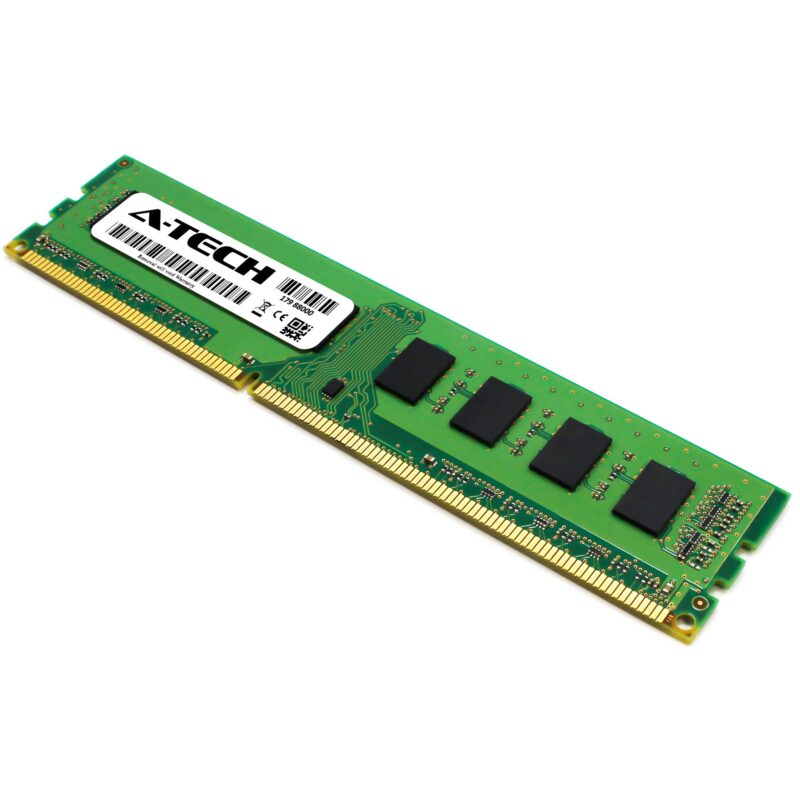


Form Factor and Compatibility
DDR3 memory modules are available in two main form factors: 240-pin DIMM for desktop computers and 204-pin SODIMM for laptops . Compatibility is determined by the motherboard’s memory slot type and supported specifications. DDR3 is not physically or electrically compatible with DDR2 or DDR4 slots, as the notch position on the module is different to prevent incorrect installation .
Frequency and Performance
1GB DDR3 modules were produced in several frequency grades. Common specifications include:
-
DDR3-1066 (PC3-8500): Operates at 1066 MHz .
-
DDR3-1333 (PC3-10600): Operates at 1333 MHz .
-
DDR3-1600 (PC3-12800): Operates at 1600 MHz .
Modules are typically single-rank (1RX8) configurations and are designed as Non-ECC, Unbuffered DIMMs for standard consumer systems . ECC (Error-Correcting Code) variants exist but are intended for server or workstation platforms .
Voltage and Electrical Specifications
Standard DDR3 memory operates at 1.5V, a reduction from the 1.8V required by DDR2, contributing to lower power consumption and reduced heat generation . Some modules may specify a voltage range (e.g., 1.7-1.9V for certain high-performance variants) . The CAS latency (CL) varies by frequency, with CL9 being common for 1333MHz modules and CL7 for 1066MHz modules .
| Specification | Detail |
|---|---|
| Memory Type | DDR3 SDRAM |
| Capacity | 1 GB (Single Module) |
| Form Factor | 240-pin DIMM (Desktop) / 204-pin SODIMM (Laptop) |
| Frequency Options | 1066 MHz, 1333 MHz, 1600 MHz |
| Bandwidth | PC3-8500, PC3-10600, PC3-12800 |
| Voltage | 1.5V (Standard) |
| CAS Latency | CL7 – CL9 (varies by frequency and model) |
| Configuration | Non-ECC, Unbuffered (typically) |
| Compatibility | Desktop or laptop motherboards with DDR3 slots |


Reviews
There are no reviews yet.